Supreme Arbor, LLC is a founder-led tree care company serving Holly Springs, GA and the Sixes Road / Hickory Flat corridor. Founder Iruku Makanga and his family have called Cherokee County home for 30 years. Services include tree removal, hazardous tree work, pruning, stump grinding, storm damage cleanup, and rented crane arrangements when specialized lifting equipment is required. Customers can call (470) 863-3083 for prompt assistance.
Holly Springs Tree Permit & Risk Checker
Check if your tree work requires city permit review or GA EPD stream buffer authorization.
Select Property Location:
Holly Springs GA Tree Ordinance & Service Overview
The City of Holly Springsrequires tree protection reviews during residential additions, clearing, or major site work. Single-family homeowners doing routine yard maintenance on non-Heritage trees outside stream buffers are generally exempt.
Supreme Arbor, LLC provides tree removal, structural pruning, storm damage assistance, and rented crane arrangements when required throughout Holly Springs, Sixes Road, and Hickory Flat. Customers can call (470) 863-3083 for assistance.
Holly Springs Tree Removal Cost Breakdown
| Holly Springs Subdivision Service | Neighborhood Investment Range | Equipment & Zero-Lot-Line Safeguards |
|---|---|---|
| Subdivision Canopy Thinning & Roofline Clearance (< 25 ft) | $290 - $590 | 10-foot structure clearance, deadwood reduction, HOA architectural review compliance |
| Zero-Lot-Line Pine Spar Removal (25 - 55 ft) | $680 - $1,350 | Tight-drop friction lowering, turf matting, backyard gate access chipper |
| Harmony on the Lakes Crane Hoist (55 - 85+ ft) | $1,380 - $2,700+ | Over-roof crane extraction, swimming pool perimeter rigging, ANSI A300 precision |
| Subdivision Lawn Stump Grinding (Add-on) | $160 - $390 | Root flare mulch excavation, underground utility locate verification via GA811 |
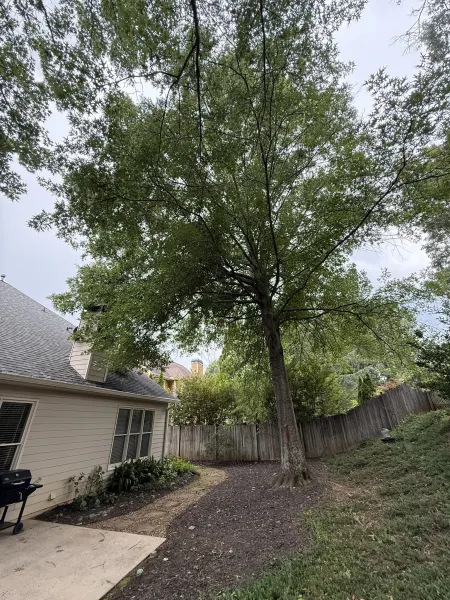
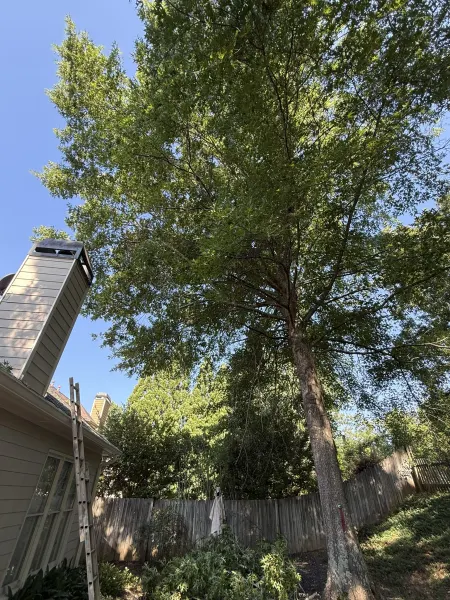
Residential Roof Clearance & Hazard Dismantling
10-foot roofline safety buffers and controlled hazardous tree removal in Cherokee County subdivisions.
Verified Local Business Information
Frequently Asked Questions: Tree Removal in Holly Springs, GA
Does Supreme Arbor provide crane-assisted tree removal?
Yes. Supreme Arbor can coordinate specialized equipment when appropriate, including crane-assisted tree removal. Crane use depends on the tree, site access, surrounding structures and overall project requirements.
What can be done with the wood chips and logs?
Options include hauling away the wood and debris, leaving wood chips on the property, or cutting suitable wood for firewood. Other options include grinding the stump. Available options and any related costs will be discussed and included in the project estimate.
What are the Holly Springs UDC Article 9 canopy replacement ratios?
Under Holly Springs Unified Development Code Article 9, residential lot disturbances exceeding 5,000 square feet require replanting at a 1:2 caliper replacement ratio. A landscape architect-prepared planting schedule must accompany the grading permit application. Replacement trees must be nursery-grown, minimum 3-inch caliper, and installed within 90 days of project substantial completion. Inspections are conducted by the Holly Springs Inspections Division to verify compliance before final certificate of occupancy issuance.
How does the Little River FEMA Zone AE floodplain affect tree work in Holly Springs?
The Little River watershed bisects Holly Springs along its Sixes Road and Big Creek Road corridors. Properties within FEMA-designated Zone AE (Annual Chance 1% Flood) require a Floodplain Development Permit from the Holly Springs Building Division prior to any land disturbance, including stump excavation and root grinding. The applicable FIRM panel for most Holly Springs residential areas is FEMA Map Panel 13057C0350E, dated November 2016. Our estimators review FIRM panel designations during site visits before quoting floodplain-adjacent removal projects.
Are trees near the Canton Highway and Sixes Road intersection subject to GDOT right-of-way restrictions?
Georgia Department of Transportation maintains a variable right-of-way easement along SR-20 (Canton Highway) and SR-140 (Sixes Road) through Holly Springs. Trees within the GDOT right-of-way boundary are state property managed under GDOT Maintenance Policy Section 952-5020. Private property owners whose lots abut the right-of-way must obtain a GDOT Encroachment Permit before removing any tree with canopy extending into the corridor. We assist homeowners in verifying right-of-way boundaries using GIS parcel data and coordinate permit filings when encroachment permits are required.
How do Holly Springs residential parcel constraints compare with neighboring jurisdictions?
Holly Springs residential enclaves such as Harmony on the Lakes, Barrett Farms, and Hollymont feature distinct physical challenges compared to outlying acreage. Compact home footprints with zero-lot-line rear easements mean that crane outriggers must span custom flagstone patios, submerged french drains, and subterranean swimming pool conduits without triggering hydraulic surface fractures. Professional crews operating within Holly Springs coordinate directly with homeowner association architectural review boards to verify covenant compliance, coordinate independent ISA arborist condition reports when required, and execute precision rigging maneuvers utilizing specialized equipment that navigate narrow 36-inch garden gates.
Which indigenous tree varieties require hazardous extraction in Holly Springs?
Municipal residential calls in Holly Springs most frequently address failing Virginia scrub pine stands impacted by pitch moth larvae, mature southern red oak (Quercus falcata) suffering chronic hypoxylon canker lesions (Biscogniauxia atropunctata), and Eastern redcedar (Juniperus virginiana) displaying widespread cedar-apple rust (Gymnosporangium juniperi-virginianae) galls. In older creek bottoms flanking Hickory Flat, brittle boxelder (Acer negundo) and decayed mockernut hickory (Carya tomentosa) infested by wood-boring hickory bark beetles (Scolytus quadrispinosus) frequently experience catastrophic trunk shear during severe thunderstorm microbursts, necessitating articulated knuckle-boom crane extractions past manicured ornamental turfgrass.
Holly Springs Tree Service Reference: Permits, Soil, & Regulatory Contacts
City of Holly Springs Permit Contacts
• Building & Planning: 3235 Holly Springs Pkwy, Holly Springs, GA 30115
• UDC Article 9 Inquiries: Holly Springs Planning Division, 678-819-2050
• Floodplain Administrator: Holly Springs Engineering Dept, 678-819-2060
• Inspections Division: Final landscaping inspection booking, 678-819-2070
• GDOT Permit Office: SR-20/Sixes Rd encroachment permits, GDOT District 7
• CCWSA Utility Easements: Cherokee County Water & Sewerage Authority (Little River trunkline crossings), 770-479-1813
• Sixes Station 22 Liaison: Emergency arterial road blockage response coordination
Soil & Geology: Holly Springs Site Conditions
Subsurface strata across the Holly Springs municipal territory comprise weathering crystalline residuum of the Georgia Piedmont geological province. Soil surveys document pervasive Cecil series saprolitic subsoils and Madison gravelly complexes possessing slow internal percolation rates. Saturated clayey substrata contiguous to the Little River fluvial channel exhibit hydraulic conductivity below 0.06 inches/hour, forming perched seasonal water tables that foster Phytophthora root decay in landscaped dogwoods and shade trees. Heavy mechanical stump grubbing along saturated creek contours requires trench box stabilization compliant with OSHA 29 CFR 1926.652 safety mandates.
FEMA Flood Zone Designations: Holly Springs
• Zone AE: 100-year floodplain along Little River mainstem corridor
• Zone X (Shaded): 500-year floodplain overlay covering Sixes Road tributaries
• Zone X (Unshaded): Minimal flood hazard (most upland Holly Springs subdivisions)
• FIRM Panel: 13057C0350E (effective November 4, 2016)
• LOMA Application: Letter of Map Amendment for properties incorrectly mapped in AE zone, FEMA Mapping Center Kansas City
Holly Springs Subdivisions & Enclaves Served: Harmony on the Lakes (The Peninsula, The Summit, The Springs, The Overlook, The Falls) · Holly Glen · Barrett Farms · Bridgemill Crossing · Bridgestone Estates · Caldwell Trace · Appalachee Pointe · Holly Springs Farms · Big Creek Crossing · Sixes Road Enclave · Avery Landing · Ellington · Foxwood · Greenfield · Northgate Crossing · Oak Creek Pointe · Stonegate · Picketts Ridge · Hidden Creek · Bradshaw Walk · Hollymont · Mountain Brook · Victoria Crossing · Stoney Creek
Arboricultural operations likewise encompass J.B. Owens Park acreage, Palm Street historic quarter, Univeter Road residential tracts, Butterworth Road homesteads, Cagle Dairy pastures, Marble Quarry Road hillside properties, and unincorporated Hickory Bluff parcels.
Holly Springs Subdivision & Canopy Protection Standards
| Subsystem & Rigging Capability | Subdivision Residential Specification | Holly Springs Homeowner Protection |
|---|---|---|
| Master-Planned Community Crane Access | Coordinated specialized equipment & crane assistance (arranged as site conditions require) | Extracts hazardous tall pines over zero-lot-line rooftops in Harmony on the Lakes with ground protection mats to protect residential landscaping |
| HOA Ground & Driveway Protection | Heavy-duty ground protection mats | Prevents cracking on decorative concrete driveways and protects community curb landscaping |
| Stormwater & Retention Pond Rigging | O.C.G.A. § 12-7-1 & 25-ft state waters compliance | Enables safe mechanical trimming of hazardous embankment timber without violating GA EPD silt regulations |
| Clean Chipping & Debris Removal | Commercial wood chipper | Processes brush and branches on site for efficient debris cleanup |
| Commercial General Liability | $2 million in Commercial General Liability Insurance | Commercial general liability coverage for residential tree care and removal |
Verification & Review Record
Holly Springs Master-Planned Community & Riparian Canopy Management
Holly Springs features premier planned residential neighborhoods including Harmony on the Lakes, Holly Glen, and Barrett Farms, where spacious single-family dwellings sit adjacent to protected community lakes, walking trails, and stormwater retention reservoirs. Managing mature native hardwoods in these dense community settings demands surgical rigging expertise and detailed knowledge of both municipal tree density units and HOA architectural mandates.
HOA Architectural Review Packets
Most Holly Springs subdivisions require formal HOA approval before removing live hardwoods over 8 inches in trunk diameter. We prepare detailed tree documentation packets and coordinate with independent ISA Certified Arborists when certified evaluation or reporting is required to expedite covenant approval workflows.
Retention Pond & Lake Buffer Protection
Properties bordering community retention basins or Little River drainage feeders fall under Georgia Environmental Protection Division buffer rules. Our controlled rigging with ground protection mats extracts declining specimens from shoreline banks without disturbing aquatic vegetative roots or violating state silt ordinances.
Zero-Lot-Line Roof & Pool Enclosures
Tight backyard setbacks frequently position tall loblolly pines directly over custom gunite swimming pools, screen enclosures, and outdoor kitchens. We use precision mobile crane picks that hoist heavy timber sections straight vertically, neutralizing all impact risks to delicate backyard improvements.
City of Holly Springs UDC Tree Ordinance & Little River Floodplain Regulations
The City of Holly Springs Unified Development Code (UDC) establishes specific canopy replacement ratios and heritage specimen preservation mandates. Under Holly Springs UDC Article 9 (Landscaping and Tree Protection), any residential lot disturbance exceeding 5,000 square feet triggers a mandatory tree replacement schedule requiring 1 caliper inch of replanted nursery stock for every 2 caliper inches of removed canopy. This replacement ratio distinguishes Holly Springs ordinance from unincorporated Cherokee County, where no such replanting obligation applies on existing single-family parcels.
Trees measuring 27 inches DBH or greater are classified as Heritage Specimens under Holly Springs UDC. Removal of any Heritage-designated oak, elm, beech, or tulip poplar requires a written petition submitted to the Holly Springs Community Development Department, accompanied by a certified arborist condition report, a proposed mitigation planting plan, and payment of a $250 application review fee prior to any clearing. Emergency hazard exceptions apply when a licensed ISA arborist certifies imminent structural failure risk.
Little River Floodplain & Stormwater Buffer Compliance
Holly Springs sits at the headwaters of the Little River watershed, a FEMA-designated Zone AE floodplain corridor that bisects multiple residential subdivisions along Sixes Road and Canton Highway. Properties within the 100-year floodplain boundary require a Floodplain Development Permit from the Holly Springs Building Department before any grading, clearing, or root excavation occurs within the floodplain envelope. Our arborists coordinate directly with the Holly Springs Engineering Department to verify lot flood zone classifications using current FIRM panel maps (Flood Insurance Rate Map Panel 13057C0350E).
| Holly Springs UDC Threshold | Regulatory Trigger | Required Documentation |
|---|---|---|
| Heritage Specimen (≥27" DBH hardwood) | Mandatory pre-removal petition to Community Development | ISA arborist report + $250 fee + mitigation planting schedule |
| Canopy Disturbance (>5,000 sq ft lot clearing) | Replacement ratio: 1 caliper inch replanted per 2 removed | Landscape architect replacement plan submitted with demolition permit |
| Floodplain Zone AE (100-yr boundary) | Floodplain Development Permit required | FIRM map reference (Panel 13057C0350E) + Engineering sign-off |
| State Waters Buffer (25 ft from Little River tributaries) | GA EPD variance or exempt hazard certification | Written hazard documentation under O.C.G.A. § 12-7-1 |
Harmony on the Lakes Canopy Covenant
Harmony on the Lakes Restrictive Covenants (Cherokee Clerk of Superior Court Instrument #2004-R008241) forbid extracting healthy hardwoods surpassing 6 inches trunk diameter without authorization from the Architectural Control Committee. Covenants mandate assessment penalties of per unauthorized stem and restitution planting consisting of two certified nursery saplings. Supreme Arbor furnishes complete arborist affidavits satisfying community review requirements.
Catchment Basin Vegetative Buffers
The municipality mandates a 10-foot non-disturbance vegetation buffer surrounding residential catchment basins governed by Cherokee County Engineering Standards (Chapter 4, Subsection B). Hazardous or declining timber threatening spillway basins is extracted using mat-supported turf cranes to safeguard engineered side-berms and bentonite sealant liners from heavy rutting.
Barrett Farms & Holly Glen Legacy Hardwoods
Barrett Farms and Holly Glen neighborhoods harbor century-old northern red oak and pignut hickory relic groves established prior to suburban platting. Evaluating these ancient canopy giants requires advanced sonic tomography testing by credentialed arborists to quantify internal decay columns, a rigorous assessment standard distinct from rural timbering practices.
Holly Springs Hydrogeology, Saprolite Soils & Canopy Failure Mechanics
The subsurface lithology of Holly Springs is characterized by mica schist and biotite gneiss bedrock overlain by deep residual saprolite horizons. Unlike the river terrace alluvium found near low-lying river bottoms, upland Holly Springs parcels situated along Hickory Road, Univeter Road, and Marble Quarry Road rest upon dense weathering mantles where clay minerals swell dramatically during prolonged precipitation cycles, leading to distinctive root-plate shear and biomechanical instability.
Saprolite Shear & Root-Plate Heave
During severe Piedmont frontal storms, perched water saturates the boundary between the upper Cecil B-horizon clay and the crumbly micaceous saprolite below. Taproots lose tensile frictional anchorage, precipitating sudden root-plate rotational uprooting even in moderate 45-mph gale bursts. We deploy sonic tomography and digital micro-drilling resistance meters to gauge internal trunk decay before executing technical takedowns.
Fungal Spore Pathology: Heterobasidion
In residential stands across Picketts Ridge and Hidden Creek, Heterobasidion annosum root decay rapidly inoculates freshly severed conifer stumps via airborne basidiospores. Without prompt application of granular disodium octaborate tetrahydrate sporicide to cut stump surfaces, fungal mycelia migrate through subterranean root grafts into adjacent healthy specimen trees within 18 to 24 months.
Tracked Spider-Lift Rigging Logistics
Tight residential boundaries in Harmony on the Lakes preclude 40-ton boom truck access. Our arborists deploy rubber-tracked compact articulating aerial platforms with ground-bearing pressure below 5.5 psi. These ultra-narrow machines access secluded courtyards through standard pedestrian gates, safely dismantling towering dead conifers without cracking subterranean drainage conduits or rutting manicured zoysia sod.
Little River Riparian Soil Series & Alluvial Geochemistry (Holly Springs Quadrangle)
Soil mapping across the Holly Springs municipal quadrangle delineates three primary USDA NRCS taxonomies: Chewacla silt loam (Ch) along bottomland flood benches, Madison gravelly sandy loam (MdB2) on 2-10% transitional slopes, and Pacolet-Cecil intergrades (CeB2) occupying ridge crests. High mica content in Chewacla alluvium reduces shear strength when river stages crest bankfull discharge, causing sudden bank sloughing and undercutting riparian willow, persimmon (Diospyros virginiana), sourwood (Oxydendrum arboreum), and winged elm (Ulmus alata). Mitigating these hazard corridors requires specialized floating winch lines and synthetic friction snubber rigging anchor systems anchored to upland granite outcroppings.